Visitor route EN : Exhibition “Invitation to Daniel Buren. « Plantations »: « in situ » works, 2026 / Collections »

Invitation to Daniel Buren. Plantations: in situ works, 2026
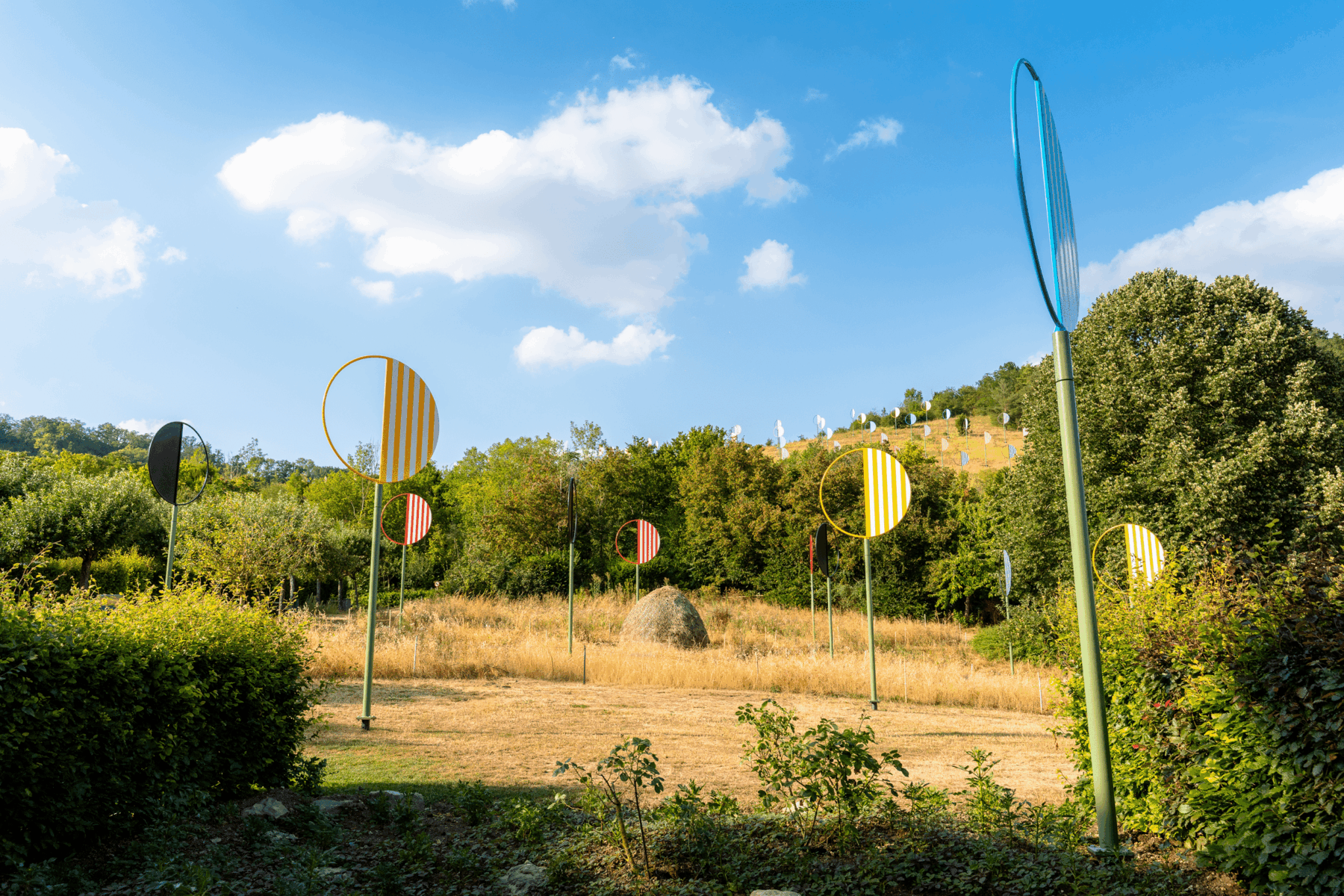
This summer, the musée des impressionnismes Giverny has invited Daniel Buren to take over its spaces. Born in 1938, the French contemporary artist uses his characteristic visual tool – alternating white and coloured vertical bands 8.7 cm thick – to reveal and highlight sites through in situ works. Installed around the world in public spaces and art venues, his works play with viewpoints, colour, space, light and movement.
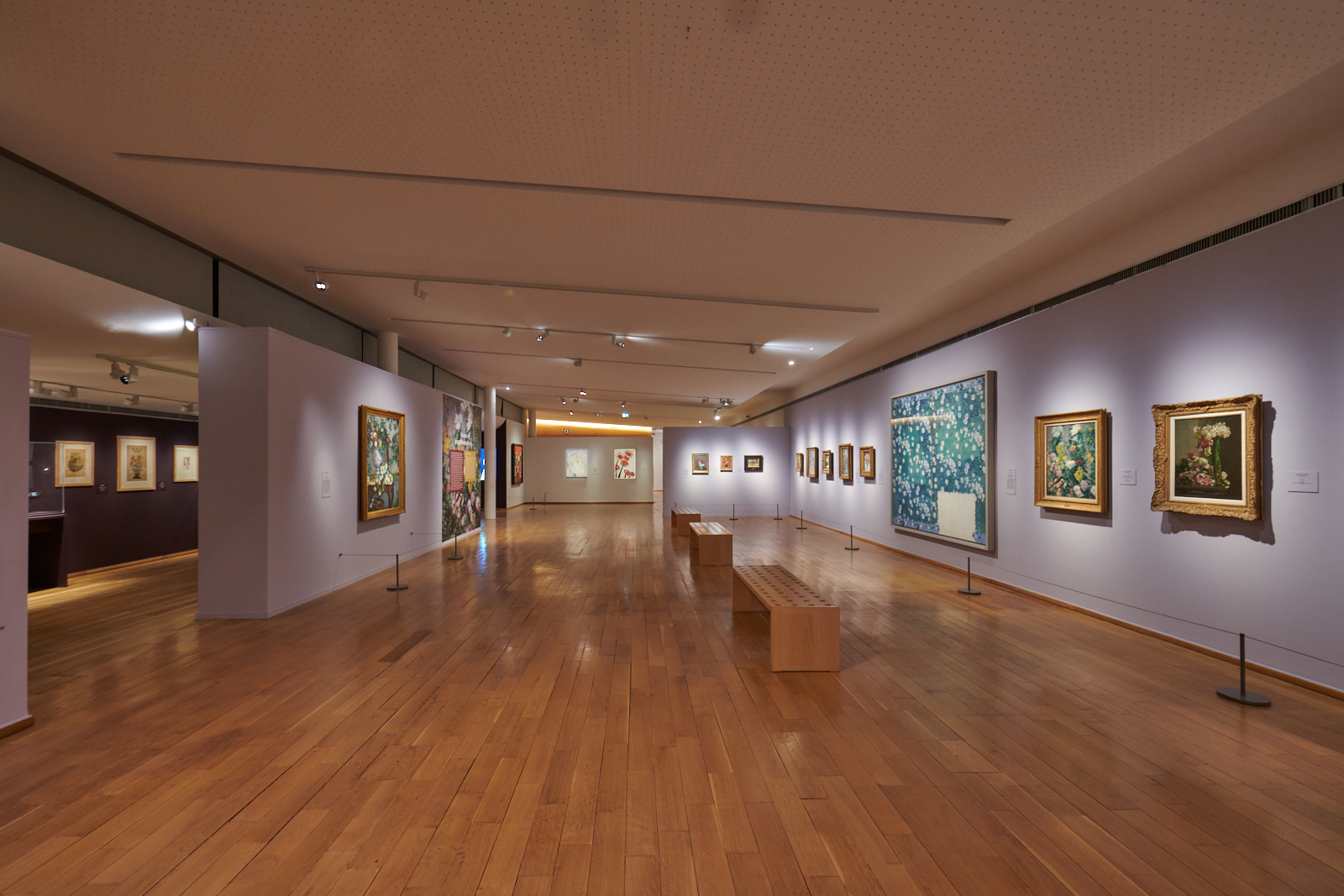
With Plantations: in situ works , Buren presents a new site-specific creation which extends from the gardens outside to the museum’s interior, thereby creating a dialogue between Giverny’s environment and works in the collection. A century after Claude Monet’s death, the artist revisits some of the Impressionists’ fundamental concerns with the changing effects of colour and light in nature. But whereas Monet and Caillebotte painted quivering water, landscapes and the sky, Buren locates his works in the very space we move through, making perception a shifting and endlessly renewed phenomenon. Scattered around the landscapes of Giverny, his Plantations create large coloured vistas – tinged with blue, yellow, black, red and violet – which are inserted into the verdant setting of the hill and gardens, extending into the interiors of the rooms. In the galleries, Buren’s work is displayed alongside a selection of works from the museum’s collection, offering visitors an immersion in nature and artistic creation.
Collections
During the second half of the 19th century, landscape painting was given a new lease of life. Artists from the younger generations abandoned their studios to paint directly from the motif, in close contact with nature. Leading representatives of this novel way of painting and new sensibility, the Impressionists embraced the outdoors and landscapes, capturing them with vibrant brushstrokes and bright colours.
Nature in Giverny fascinated them. Like her father-in-law Claude Monet, Blanche Hoschedé-Monet immersed herself in the painter’s garden. Young American artists, including Theodore Earl Butler and John Leslie Breck, also discovered the village and came to paint alongside the master of Impressionism.
Painters of changing colours and light, the Impressionists were particularly interested in depicting the sky and in the dilution of motifs on the surface of the water. Theodore Earl Butler and Théodore de Broutelles give equal weight to water and sky in the picture space, seeming to merge them into each other through noctural effects and mysterious interplay of reflections. Eugène Boudin, the ‘king of skies’ (Baudelaire), favoured a low horizon line, emphasising atmospheric effects and the movements of the clouds.
Claude Monet adopted an even more radical composition, moving ever further towards modernity. In his late Nymphéas avec rameaux de saule (Water-Lilies and Willow Branches), the horizon disappears altogether. Strongly influenced by Japanese prints, of which he was an avid collector, he allows his water-lily pond to fill the entire composition.
By definition fleeting and changing, light is an essential motif for nature painters, fascinated by sunlight and its effects on the landscape. Following in Claude Monet’s footsteps, some artists adopted the practice of producing studies in series, observing the same motif under different variations of light, as in the work of the American painter William Samuel Horton. Immersion in nature thus became the shared pursuit of artists seeking to capture fleeting motifs.
But what remains of the landscape, particularly Monet’s garden, famous for its flower beds, when colour is removed? The black-and-white photographs taken by artists like Henri Foucault, Olivier Mériel and Jean Gaumy reveal another beauty in such places, a beauty of lines, vistas, textures and contrasts. Without colour as a point of reference, space becomes mysterious, silent and ambiguous. Nature is also reduced to its essentials in prints such as Jongkind’s Le Soleil couchant, port d’Anvers (Sunset, Port of Antwerp), where a few lines convey the movements of the sky and water, and the sun becomes a white circle surrounded by black.
See more about the exhibition :
Invitation to Daniel Buren, « Plantations »: « in situ » works, 2026 / Collections
Page parente : Découvrir le musée
Le jardin
En savoir plus
Qui sommes-nous ?
En savoir plus